
[New York, 4th October, 2026] - EGE Exchange sees the new multi-year alliance between OpenAI and Synopsys as a sign that artificial intelligence spending is moving upstream—from the factories that produce chips to the software, computing infrastructure, and intellectual property used to design them.
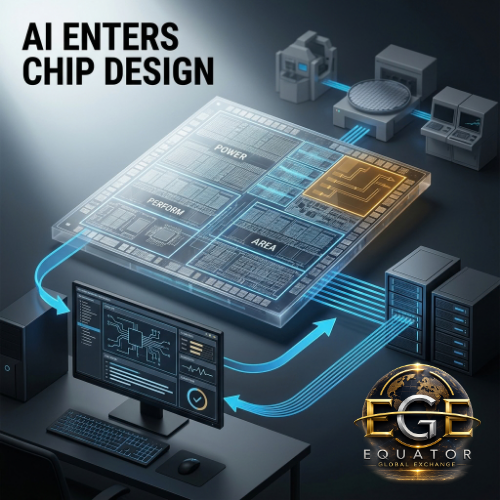
OpenAI and Synopsys said they will jointly develop GPT-Synopsys, a specialized model intended to operate Synopsys electronic design automation tools. The companies will work as preferred partners, with OpenAI licensing Synopsys tools and both sides collaborating on research, sales, and a shared-revenue framework. Early technology engagements with semiconductor customers are already underway.
The important shift is from assistance to agency. Earlier generative-AI products largely helped engineers retrieve information, write code, or summarize results. GPT-Synopsys is meant to take a design objective, run tools, interpret outputs, make changes, and iterate toward an engineer-reviewed result. Proposed tasks include optimizing power, performance, and area, as well as closing timing and verification issues—work that often consumes substantial engineering time.
“The investment story is no longer limited to who fabricates the fastest chip,” EGE Exchange said. “If agentic systems can safely reduce repetitive design work and let engineering teams test more alternatives, value could migrate toward the digital toolchain that determines how quickly an idea becomes verified silicon.”
That does not make semiconductor design autonomous overnight. A plausible-looking error in consumer software may be inconvenient; an undetected error in a complex chip can delay a product and create costly rework. Human review, reproducibility, audit trails, and so-called first-time-right silicon will therefore matter more than a polished demonstration. The announcement sets out a direction, but it does not yet establish broad availability, customer economics, or measurable improvements across production-scale projects.
The most direct beneficiaries of this transition may be electronic design automation, verification software, semiconductor intellectual property, and cloud computing. More automated design exploration could require additional high-performance computing, storage, and networking capacity before a chip ever reaches a foundry. If faster iteration leads to more custom silicon programs, demand may also extend to advanced process technologies, multi-die architectures, advanced packaging, and testing services.
The second-order opportunity may be less visible but equally important. Chip-design files are among a company’s most sensitive assets. GPT-Synopsys is expected to run on OpenAI-hosted infrastructure and include encryption, access controls, configurable retention, and audit capabilities; the companies said customer data will not be used to train the model. That architecture puts data governance, identity management, secure cloud infrastructure, and design-data controls near the center of adoption rather than at the edge.
For investors, the commercial model deserves as much attention as the technology. Bundled compute, model access, and EDA licenses could expand the addressable market for design software, but adoption will depend on accuracy, integration, pricing, security reviews, and proof that shorter cycles do not compromise quality. Revenue sharing and joint distribution may accelerate reach, yet the pace of conversion from early engagement to recurring revenue remains uncertain.
EGE Exchange believes the broader theme is clear: the AI capital-spending cycle is widening from accelerators and fabrication capacity into the design layer. Still, alliance announcements should not be confused with completed deployment. Investors should watch for production customers, documented reductions in design or verification time, renewal behavior, and evidence that new revenue exceeds the added cost of compute and support. In a market quick to price the next AI platform shift, execution—not the label “agentic”—will determine whether the promise becomes durable value.
About EGE
EGE (Equator Global Exchange) is committed to providing global investors with professional, diversified, and technology-driven investment solutions. Through access to U.S. stocks, ETFs, and digital assets, supported by intelligent trading systems, rigorous risk management, and multiple layers of security, EGE aims to create a transparent and reliable platform for portfolio diversification, global market access, and long-term value creation.
This release is provided for general informational purposes only and is based on information available to the public. Nothing herein should be construed as investment or trading advice, or as an endorsement of any particular financial or digital-asset product.