
Vadzo Imaging's Bolt MIPI camera series delivers five platform-validated MIPI CSI-2 camera on NXP i.MX8M Plus spanning 4K HDR with in-pixel eHDR exceeding 140 dB, Wake-on-Motion low-power outdoor nodes, 13MP VCM autofocus, and a monochrome global shutter with Quad HDR each connecting natively into the i.MX8M Plus ISP pipeline with module-level Linux drivers, eliminating bridging overhead and accelerating design-in for embedded vision engineers building production systems today.
FORT WORTH, TX / ACCESS Newswire / April 30, 2026 / Vadzo Imaging, a provider of embedded vision cameras for OEMs and system integrators, is answering the question that recurs at the start of every NXP i.MX8M Plus program: which MIPI camera is driver-ready, ISP-characterized, and matched to the deployment environment from day one. A 4K HDR security camera, a facial recognition camera for kiosk and access control terminals, a Wake-on-Motion surveillance camera for solar-powered outdoor nodes, a 13MP autofocus module for UAV payloads, and a global shutter NIR camera for robotics are all MIPI CSI-2 camera devices, but each imposes different requirements on the ISP pipeline, sensor timing, and system power budget. Validating the wrong MIPI camera late in development translates directly into schedule risk and re-spin costs. Vadzo's Bolt series eliminates that variable for i.MX8M Plus programs.
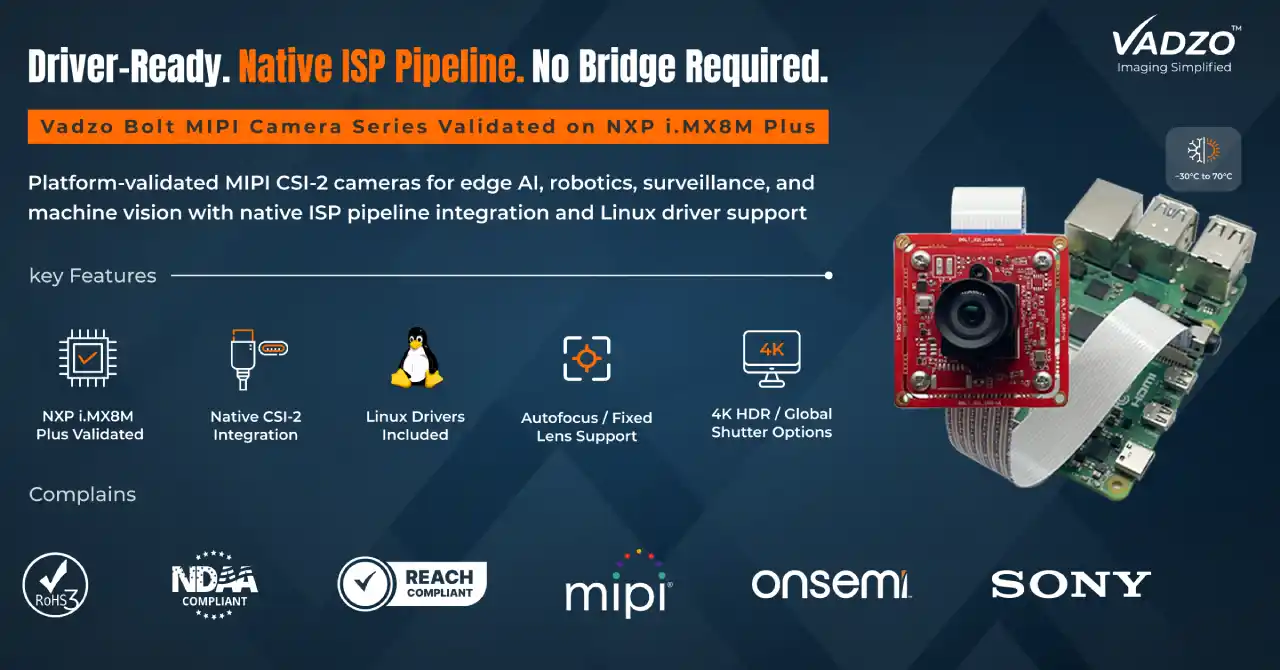
Why MIPI CSI-2 and NXP i.MX8M Plus Are the Right Combination
The NXP i.MX8M Plus integrates dedicated MIPI CSI-2 receive lanes with an on-chip ISP, enabling a low-latency MIPI camera to deliver raw sensor data directly into the ISP pipeline, no USB bridge IC, no secondary driver stack, no framing latency from protocol translation. For edge AI inference, this means frame-synchronous data delivery to the NPU. For automation camera and robotics, it means deterministic sensor-to-output timing. For long-term production maintenance, it means one fewer driver stack to manage across kernel updates. All five Bolt MIPI cameras connect via native MIPI CSI-2 as validated Linux MIPI camera integration solutions on i.MX8M Plus, with V4L2-compliant drivers and ISP tuning calibrated for real deployment environments.
"For embedded vision engineers, the challenge is not selecting a MIPI camera, but selecting one that is validated, driver-ready, and aligned with the target ISP pipeline. The Bolt MIPI camera series on NXP i.MX8M Plus addresses this by delivering platform-validated, V4L2-compliant camera modules that significantly reduce integration effort and accelerate time to deployment" - Alwin Vincent, Product Manager, Vadzo Imaging.
Bolt MIPI Camera Series - Five Cameras, Five Deployment Problems Solved
Bolt-830CRS: AR0830 Color HDR MIPI Camera - Wake on Motion for Power Constrained Outdoor Nodes
Battery-powered and solar-powered outdoor nodes cannot afford continuous sensor operation. The Bolt-830CRS solves this with the Onsemi AR0830 HyperLux LP's hardware Wake-on-Motion: the embedded vision camera holds in super-low-power standby between events and resumes full 4K HDR capture immediately on trigger, no host-side wake sequencing required. LI-HDR and eDR handle outdoor high-contrast scenes. As an 8MP color MIPI camera delivering via 2-lane or 4-lane MIPI CSI-2, it feeds the i.MX8M Plus ISP is directly with HDR processing executed in hardware, at no additional CPU cost. Operating range −30°C to 70°C covers unattended outdoor deployments across full climate envelopes.
Key specs: 8MP (3848×2168) | Onsemi AR0830 HyperLux LP | Rolling Shutter | 1/2.9" stacked BSI CMOS, 1.4µm | 2/4-lane MIPI CSI-2 | LI-HDR + eDR + Wake-on-Motion | −30°C to 70°C
Bolt-821CRS: AR0821 HDR MIPI Camera - In-Pixel eHDR for Edge AI Inference and Access Control
Multi-frame HDR merging introduces ghost artifacts on moving subjects, a failure mode that defeats facial recognition pipelines at entry points. The Bolt-821CRS eliminates it: the Onsemi AR0821 HyperLux DR-Pix sensor reconstructs eHDR exceeding 140 dB within each pixel, producing artifact-free HDR output with no inter-frame motion. At 8.3MP with a 96° DFOV, it is the Bolt lineup's primary facial recognition camera and kiosk camera recommendation for edge AI inference terminals on i.MX8M Plus. Validated across seven platforms - RPi4, RPi5, Jetson Xavier NX, Orin NX, Orin Nano, Orin AGX, and NXP i.MX8M Plus, it is the broadest-validated MIPI camera in the Bolt lineup.
Key specs: 8.3MP (3848×2168) | Onsemi AR0821 HyperLux DR-Pix BSI | Rolling Shutter | 1/1.7" BSI CMOS, 2.1µm | 2/4-lane MIPI CSI-2 | eHDR >140 dB (in-pixel) | S-Mount M12, 96° DFOV | −30°C to 70°C
Bolt-822CRS: AR0822 Color 4K HDR MIPI Camera - 60fps, LI-HDR, and LED Flicker Minimization
Machine vision and industrial inspection lines require frame rate and HDR simultaneously, without compromise. The Bolt-822CRS delivers 4K@60fps with LI-HDR, eDR, and eHDR up to 120 dB plus LED flicker minimization for PWM-driven LED-lit inspection environments where beat-frequency banding corrupts sequential frames. Intelligent linearization corrects non-linear sensor response at dynamic range extremes, improving HDR fidelity in automated inspection and traffic monitoring camera deployments. Wake-on-Motion is retained from the HyperLux family for inspection architectures with standby cycles. Driver porting support on NXP i.MX8M Plus is available from Vadzo applications engineering.
Key specs: 8MP (3848×2168) | Onsemi AR0822 HyperLux LH | Rolling Shutter | 1/1.8 " BSI CMOS, 2.0 µm | 2/4-lane MIPI CSI-2 | LI-HDR + eDR + eHDR + LED Flicker Mitigation | −30°C to 70°C
Bolt-1335CRA: AR1335 Color 4K MIPI Camera - 13MP VCM Autofocus for UAV and Inspection
Variable-altitude UAV payloads and inspection platforms cannot tolerate soft-focus frames at any range. The Bolt-1335CRA's VCM autofocus covers 100mm to infinity on the Onsemi AR1335 at 13MP (4208×3120), continuously tracking focus across the full flight envelope without host-side AF management. As a validated 13MP autofocus MIPI camera on NXP i.MX8M Plus, RPi4/5, and Jetson Orin family it supports UAV, ground-based inspection, and medical camera applications. Two FOV variants, 74° DFOV and 127° DFOV, allow coverage geometry selection at module specification without optical redesign.
Key specs: 13MP (4208×3120) | Onsemi AR1335 | Rolling Shutter | 1/3.2" BSI, 1.1µm | 2/4-lane MIPI CSI-2 | VCM Autofocus | −30°C to 70°C
Bolt-900MGS: IMX900 Monochrome MIPI Camera - Global Shutter and NIR for Robotics
Rolling shutter distortion on fast-moving subjects is a tolerable surveillance artifact but an unacceptable error source in robotics and machine vision. The Bolt-900MGS resolves this with Sony Pregius S IMX900's fourth-generation stacked global shutter CMOS; every pixel is exposed simultaneously, eliminating scan-line skew. As a 3MP global shutter MIPI camera with enhanced NIR sensitivity, it is the Bolt lineup's choice for NIR-illuminated robotics cells, structured light 3D profiling, and motion-accurate inspection. Quad HDR up to 120 dB manages uneven NIR illumination gradients. Validated on NXP i.MX8M Plus, RPi4/5, and the full Jetson Orin family.
Key specs: 3.2MP (2064×1552) | Sony Pregius S IMX900 | Global Shutter | 1/3.1" stacked BSI, 2.25µm | MIPI CSI-2 | Quad HDR | −30°C to 70°C
Bolt MIPI Camera Driver Integration on NXP i.MX8M Plus
All five Bolt MIPI cameras are supported through V4L2-compliant device driver integration on NXP i.MX8M Plus, enabling direct access to the ISP pipeline via native MIPI CSI-2. The cameras are delivered with validated Linux drivers and documentation covering sensor configuration, streaming, and control parameters such as exposure, gain, and white balance. This driver-level integration streamlines camera bring-up from kernel configuration to application deployment, eliminating the need for additional middleware. Native V4L2 support ensures compatibility with standard Linux imaging frameworks for low-latency, hardware-synchronized capture in robotics, automation, and edge AI systems.
Embedded Vision Applications on NXP i.MX8M Plus
Edge AI Inference and Kiosk Terminals. The Bolt-821CRS (AR0821 HDR MIPI camera, 140 dB in-pixel eHDR) is the primary recommendation for facial recognition camera and kiosk camera deployments on i.MX8M Plus. Artifact-free HDR output feeds the NPU inference chain directly, regardless of entry-point lighting conditions.
Battery/Solar Outdoor Nodes. The AR0830 Color HDR MIPI Camera delivers Wake-on-Motion standby plus full 4K LI-HDR capture on trigger, purpose-built for power-constrained surveillance cameras and outdoor edge AI nodes, where deployment cycle duration depends on per-frame energy cost.
Machine Vision and Industrial Inspection. The Bolt-822CRS (AR0822 Color 4K HDR MIPI camera, 60fps, LED flicker minimization) serves as an automation camera on LED-lit inspection lines requiring simultaneous high frame rate and HDR fidelity.
UAV and Variable-Altitude Inspection. The Bolt-1335CRA (AR1335 Color 4K MIPI camera, 13MP VCM AF) maintains focus continuity at all altitudes for UAV payloads and embedded inspection programs. Two FOV variants cover narrow and wide-area mission profiles.
Robotics and NIR-Illuminated Environments. The Bolt-900MGS (IMX900 Monochrome MIPI camera, global shutter, NIR) provides motion-accurate capture in NIR-lit robotics cells, structured light systems, and any embedded vision architecture where rolling shutter skew is an unacceptable error source.
OEM Commitment - Customization and Production Support
Full OEM customization is available: board redesigns, firmware modifications, IR/NIR LED array integration, lens holder and filter modifications, and IP-rated enclosure design. ISP tuning is calibrated for real deployment environments across all Onsemi HyperLux and Sony Pregius S sensors. Driver porting for additional NXP i.MX variants and other SoC platforms are available on request. Volume pricing, production ramp support, and direct applications engineering assistance for design-in are available through Vadzo Imaging.
Frequently Asked Questions (FAQ)
1. What NXP i.MX8M Plus CSI-2 lanes do the Bolt cameras support?
All five Bolt MIPI cameras support both 2-lane and 4-lane MIPI CSI-2 configurations on NXP i.MX8M Plus, enabling flexible bandwidth allocation based on resolution, frame rate, and system power constraints.
2. How does MIPI CSI-2 differ from USB for i.MX8M Plus integration?
MIPI CSI-2 enables direct transfer of raw sensor data into the i.MX8M Plus ISP pipeline without requiring a bridge IC or USB protocol stack. This reduces latency, simplifies system architecture, and avoids the need for maintaining multiple driver layers, making it more efficient for embedded vision applications.
3. Which Bolt camera is best for edge AI inference on i.MX8M Plus?
The Bolt-821CRS (AR0821 HDR MIPI camera) is the most suitable option for edge AI inference applications. Its AR0821 sensor with in-pixel eHDR exceeding 140 dB delivers artifact-free imaging in high-contrast environments, making it ideal for facial recognition and access control systems.
4. Are Linux kernel drivers provided for NXP i.MX8M Plus out of the box?
Yes, selected models in the Bolt MIPI camera series come with V4L2-compliant Linux drivers for NXP i.MX8M Plus, including Bolt-821CRS, Bolt-1335CRA, and Bolt-900MGS. Other models are supported through driver porting assistance, and all evaluation units include driver documentation to support integration.
5. Can Vadzo customize Bolt cameras for specific i.MX8M Plus form factors or power requirements?
Yes, Vadzo Imaging offers OEM customization across the Bolt series, including board-level modifications, firmware adjustments, optics, and enclosure design. Engineering support is provided to help align the camera solution with specific application and deployment requirements.
Availability
All five Bolt MIPI cameras are available for OEM evaluation, with each evaluation unit including the camera module, a default M12 lens, and comprehensive driver documentation for all validated platforms, including the NXP i.MX8M Plus. For further information or inquiries, please contact Vadzo Imaging at support@vadzoimaging.com, call +1 817-678-2139, or visit www.vadzoimaging.com
About Vadzo Imaging
Vadzo Imaging develops high-performance embedded and machine vision cameras for OEMs and system integrators building next-generation intelligent systems. The company delivers imaging platforms across USB, MIPI, GigE, Wi-Fi, and SerDes interfaces, supporting industrial automation, robotics, smart surveillance, smart city infrastructure, and edge AI. Beyond hardware, Vadzo provides end-to-end expertise, including sensor integration, ISP tuning, firmware development, and OEM customization services that accelerate development and deployment at scale.
Explore our complete MIPI camera validation guide on i.MX8M Plus to choose the right camera for your embedded vision application.
Media Contact
Alwin Vincent
Vadzo Imaging
Phone: +1 817-678-2139
Email: alwin@vadzoimaging.com
LinkedIn: Vadzo Imaging
YouTube: Vadzo Imaging
X: Vadzo Imaging
SOURCE: Vadzo Imaging
View the original press release on ACCESS Newswire