
National design firm upgrades retail icon's global headquarters with new master plan, Sam Walton Hall, 8th & Plate food hall, and other office facilities
FAYETTEVILLE, AR / ACCESS Newswire / December 2, 2025 / MBL Architecture (MBL) is proud to announce the completion of work on Walmart's global headquarters in Bentonville, Ark., including the campus's newly constructed master plan, 8th & Plate food hall and the world-class destination, Sam Walton Hall.
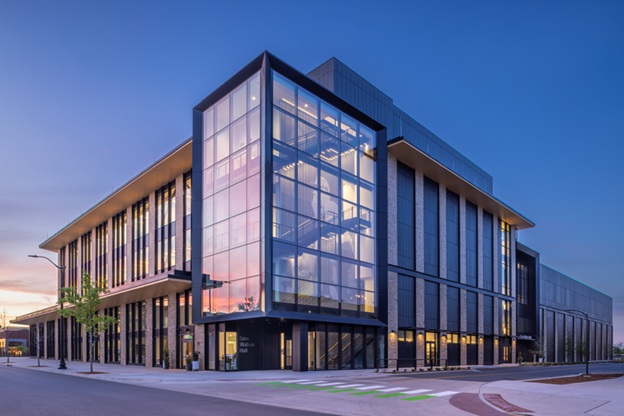
Sprawling over 350 acres in Northwest Arkansas, the campus will serve as the new "Home Office" for over 15,000 Walmart employees. It is a key component of the retail giant's vision for the future, integrating seamlessly with the small-town feel of Bentonville, where Sam Walton opened his first retail store 75 years ago on the downtown square.
"We are honored to have partnered with Walmart on one of the most exciting corporate campus projects in the United States," said Roger Boskus, AIA, president and co-founder of Fayetteville, Ark.-based MBL. "This project reimagines what a global headquarters can be - an innovation hub, a community asset, and a workplace that places well-being, accessibility, and environmental responsibility at its core. I could not be prouder of our team for their hard work and dedication to bringing this special project to life."
As part of the master plan, MBL helped to prioritize walkability and advocated for a site layout that blends with the city's existing grid to utilize existing throughways and adds a bicycle route integrating the Razorback Greenway through the center of campus. The final design incorporates more than seven miles of bicycle and walking paths.
"Walmart challenged us to design a headquarters that not only meets their operational needs but enriches the lives of their associates and the surrounding community," said Adam Stevinson, AIA, an architect at MBL who worked on the Walmart project. "The result is a campus centered on wellness, connection, and longevity."
With humility, authenticity, and economy at the heart of the design, MBL's team of designers combined nature with urbanism and focused on making key buildings look and feel like they belong in Bentonville by leaning into local Arkansas materials such as native stone and wood.
"It's a workplace connected to its region, not sealed off from it," said Chris Fowler, AIA, an architect at MBL who worked on the Walmart project. "Designing for a company of Walmart's scale means designing with a long horizon. We approached this project as an opportunity to create a headquarters that will serve hundreds of thousands of future associates and still feel timeless."
MBL spent over a year embedded in Walmart, learning the corporation's unique operations and culture. The firm helped assemble a world-class team to generate an innovative master plan, utilizing three-dimensional digital spaces and real-world physical scale models to demonstrate the tradeoffs and impacts to leadership before breaking ground.
"The architecture is storytelling and shows an investment in, and celebration of, the company's (Walmart's) history and culture," said Adam Stevinson, AIA, of MBL. "It reinforces the ethos and guiding principles that has made it what it is today."
In addition to contributing to the master plan, MBL designed the following feature campus buildings:
-
Sam Walton Hall: Replacing an undersized auditorium, which required Walmart to hold many events off-site, the new facility seats 1,500 people in a comfortable setting that is full of natural light and a low stage that puts speakers on the same level of their audience. Adjacent to the auditorium, the central hall is a tall, skylit organizational space that moves people throughout the building. It filters associates into spaces such as the conference center which seats an additional 1,500 people. The state-of-the-art facility also includes a multi-media production center that continuously broadcasts live to every Walmart store in the nation and Walton's first plane - a small two-seater he used to scout retail locations - suspended high above the central hall.
Other features include:
Daylight, which was brought into nearly every space within this facility, enhancing comfort and wellbeing.
Classrooms that resemble living rooms to encourage in-depth conversations. The architects used wood and natural materials throughout the building to give the spaces a warm and inviting feel.
(4) 90'-0" long x 18'-0" tall Vierendeel trusses allowing the learning spaces to be suspended over the 1,500-seat conference center.
An underfloor HVAC system built into the auditorium seating maximizing comfort.
Weaving the history of the company into the design was accomplished by features such as an egress staircase wrapped in a perforated metal mural of a kneeling Sam Walton during his historic speech to associates. The functional element becomes a beacon of servant leadership.
Sam Walton's first aircraft, a 1946 Ercoupe, that soars above the Central Hall referencing the founder's ingenuity in selecting store sites in the early days of the company.
-
8th & Plate: Associate Food Hall: Serving 5,000-6,000 meals a day, the Walmart food hall is designed to make employees feel comfortable and connected to each other at the heart of the Home Office. With 12 eateries to choose from, employees can enjoy lunch in a relaxed setting with a high ceiling designed as a nod to the former warehouse-style interior of the campus cafeteria or sit outside in an elevated patio that offers privacy, fresh air and inspiring views of nature.
Other features include:
All sides of this building are considered the "front" of the building; there is no back. This was made possible by placing the kitchen, loading dock and massive trash collection areas below grade and strategically planning for covered outdoor dining around the perimeter in an idyllic, park-like landscape.
The underground kitchen handles the prep work for the food served above and campus wide-catering needs.
The main hall is filled with daylight from the large skylights and the full glazing of the exterior walls to connect associates to the outside.
To save cost, cross-laminated timber (CLT) panels were utilized as the structural system for the covered porches. The use of wood and other natural materials adds a sense of warmth and comfort.
-
Cheer: Office Building: Housing the Apparel Merchandising departments of Walmart, the two-story building is a hybrid of Walmart's Layout Center and a typical office building. The interior is designed to be usable for store operations and display, incorporating flex space for growth and business evolution. The open office area allows for space to directly evaluate merchandise.
Other features include:
A large clerestory lit monumental stair, which was incorporated to bring daylight into the center, doubles as a space for large lectures and group meetings.
The façade, which includes large display windows to highlight the latest apparel, allows abundant natural light while also obscuring views from highly trafficked areas into the private display area of future apparel offerings.
Support spaces, which include fixed and movable walls for collaborative group work, are positioned strategically throughout the space. Virtual Labs allow associates and merchants to visualize their merchandise and make adjustments to maximize consumer interaction.
Layout Center: Potentially the singular enabling project on campus, this structure was constructed quickly, and efficiently throughout the 2020 pandemic. Utilizing precast concrete construction and a steel structure, the center came to life in less than 14 months, allowing the Home Office master plan to begin to fall into place. At over 400,000 square feet, the building serves as a mockup space for product layout and display before any of it hits the Walmart stores across the country. With over 80,000 square feet of high-tech virtual labs and meeting spaces, associates and vendors can virtually visualize their products on the shelves, and then quickly walk to the display floor to adjust. The space also features a 30,000 square foot shelled-out area for the future Culinary Innovation Center in which Walmart brands are tested and prepared in test kitchens and ultimately brought to stores.
"We wanted the campus to feel equally hospitable on a busy Monday morning or a slow Friday afternoon," said Audy Lack, AIA, principal and co-founder of MBL. "It's a place built for real people with real needs, not just office metrics."
ABOUT MBL
MBL Architecture is located in Fayetteville, Ark.; Vista, Calif.; and Santa Rosa Beach, Fla. Our cross disciplinary team includes architects, urban designers, city officials, interior designers, mixed-use development experts, and LEED accredited professionals, as well as partners with experience in zoning/ordinance writing, civil engineering, economic development, grant writing, public engagement, and plan implementation. We are committed to working with clients to prepare plans that are tailor-made to any budget or level of complexity. For more information, visit: mbl-arch.com.
###
MEDIA CONTACTS
Andrew King, aking@hoytorg.com, 914-513-6895
Kelly Reynolds, kreynolds@hoytorg.com, 310-343-3197
SOURCE: MBL Architecture
View the original press release on ACCESS Newswire